

Teller County
COGenWeb

Labor disturbances in 1903 caused Governor Peabody to send a company of state troops to Colorado City, where the smelter employees were on strike. This difficulty was soon adjusted, but later the miners of the Cripple Creek district ordered a sympathetic strike in those mines shipping ore to certain Colorado City smelters that they claimed had not kept their agreement. The governor then sent over 1,000 soldiers into the Cripple Creek district to maintain order and afterward declared Teller county in a state of insurrection, holding the district under martial law until February, 1904. During a large part of the same winter state troops were also employed in Telluride to assist in opening the mines there. --Extracted from 1904 Colorado History and Government by James E. Snook, page 24.
Governor Peabody's administration was tormented by a continuing series of industrial controversies. They began in April, 1903, with strikes in the mines of Cripple Creek and the mills of Colorado City. He promptly responded to a local call for troops, which were sent principally to the latter point. The outbreak, after the lapse of three or four weeks, subsided, the men returned to work, and the trouble was seemingly over. But the Western Federation of Miners was now dominated by men like William Haywood, who had determined to extend the membership of the organization to all coordinated classes of labor, such as mill and smelter men, ore handlers, machinists, engineers and supply men. Having accomplished this object, the next move contemplated was a broader and more communistic organization, which was launched the next year in Chicago and christened the Industrial Workers of the World.
The April strike had barely subsided when trouble broke out afresh, this time extending over all the coal and metal mining regions of the State. It resulted in a general tie-up of the mining industry accompanied by destruction of property, outrages to the person, forcible ejection of non-union miners, assassinations, raids on supply stores, etc. Cripple Creek soon became the most active center of the strife. The mine owners and merchants of the district promptly organized a protective association, employed an efficient peace force, and kept the county fairly free from disorder for a time. There and in San Miguel County, however, the sheriffs and the constabulary were members of the unions and woefully lax in the enforcement of the law and the protection of non-strikers against assault and outrage.
In June the National Guard was again mobilized and placed under the command of Adjutant General Sherman Bell. Except small detachments stationed at Telluride and Trinidad, the troops w7ere massed at Cripple Creek. Clashes between the military and civil authorities were of almost daily occurrence. In Teller County the sheriff and constables and some other county officers, all members of the Western Federation, were finally compelled to resign under threat of deportation. Their places were filled by the Governor with men selected by the citizens' organization. Arbitrary arrests by the military were succeeded by writs of habeas corpus from the courts, whose orders of release were in turn ignored by the Adjutant General. Finally William Moyer, President of the Western Federation of Miners, was arrested at Telluride, upon a complaint alleging desecration of the flag, and brought to Denver. The Governor having previously declared the County of San Miguel to be in a state of insurrection, the military authorities acted upon their own initiative. A writ of habeas corpus issued upon Moyer's petition brought the prisoner to Denver. The Supreme Court, after exhaustive argument, dismissed the writ, holding in effect that the Governor's proclamation of martial law was an executive act not subject to review by the Judicial Department on the return of the writ. --Extracted from 1927 History of Colorado by State Historical and Natural History Society of Colorado, volume 3, pages 932-933.
1886 Oct: Bob Womack stakes claim at Poverty Gulch, calls it "Grand View"
1890 Jul: Sherman Silver Purchase Act
1890 Oct: Gold discovered by prospector, Bob Womack, El Paso Lode
1891 Apr: Cripple Creek Mining District named
1891 Jul: William Stratton staked claims on Battle Mountain, "Independence Mine"
1891 Sep: Mollie Kathleen Mine, first to be owned by a woman.
1891 Nov: Townsite of Fremont platted by Bennet and Myers
1892 Feb: Hayden Placer "Cripple Creek" townsite platted
1893: Sherman Silver Purchase Act repealed
1893 Feb: Towns of Fremont and Hayden Placer consolidated into Cripple Creek
1893 Jul: Cripple Creek population reached 20,000
1893 Summer: Miner's strike, Over $3 for an 8-hour day of work
1893 Aug: Portland Bonaza
1894: William Stratton: First Cripple Creek Millionaire
1894: Midland Terminal standard gauge completed
1896 Apr: Cripple Creek Fire
1896 Jan: Eight men die in Anna Lee shaft cave-in at the Portland Mine
1902 Sep 14: William Stratton dies
1904 Jun 05: Thirteen non-union workers die in dynamiting of the
Independence train depot during terrorist activites
1908 Feb: Digging of Roosevelt Tunnel begins
1909 Aug 10: Bob Womack dies
1914 Nov: Cresson Mine bonanza
1931 Sep 07: Bert Carlton head of Cripple Creek Mines dies
--Compiled from 1953 Money Mountain by Marshall Sprague, 1979.
Although gold mining has not been a significant industry in Colorado for decades, cyanide allowed low-grade gold to be profitably recovered. This helped the mining industry, but worried neighbors and environmentalists. Only one major gold mine continued to carry on the nineteenth-century mining tradition, the Cripple Creek & Victor Gold Mining Company. Operating twenty-four hours a day in a major open pit mine between the two old mining towns, the company single-handedly moved gold mining back to the No. 3 position in Colorado mining, trailing only coal and gravel. It also employed about 800 people, becoming Teller County’s largest employer. Times had changed, however. The company had to blast, mechanically shovel, and process as much as 100 tons of ore to obtain an ounce of gold. The massive trucks, power shovels, and mechanical crushers used in this process would have astonished Cripple Creek miners a century ago. --extracted from 2005 Colorado: A History in Photographs by Richard N. Ellis, page 270.
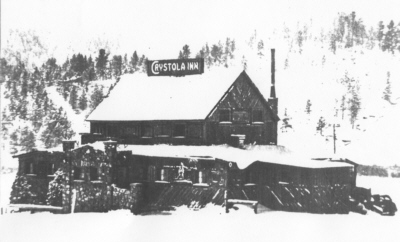
Crystolla Inn
courtesy of Ute Pass Historical Society
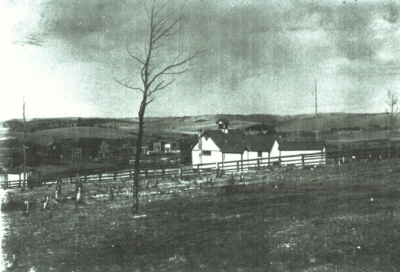
Divide ca. 1903
courtesy of Ute Pass Historical Society
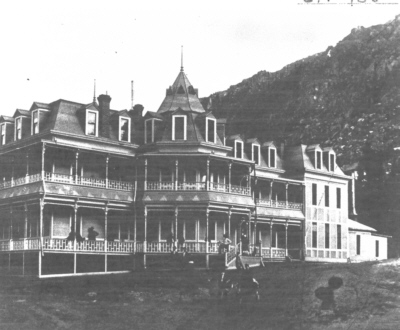
Green Mountain Falls Hotel
courtesy of Ute Pass Historical Society
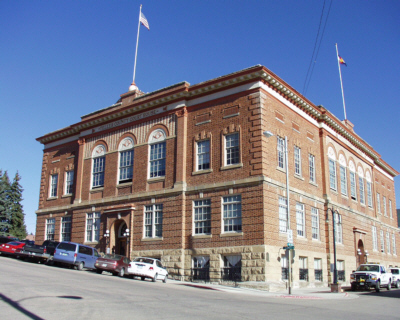
Teller County Courthouse
courtesy of Janet White, 2003
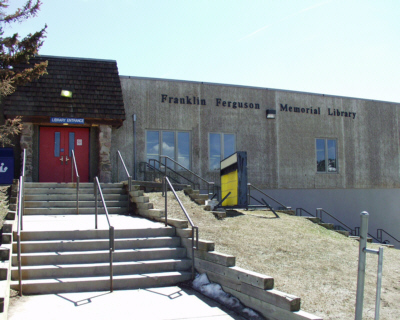
Franklin Ferguson Library, Cripple Creek
courtesy of Janet White, 2003
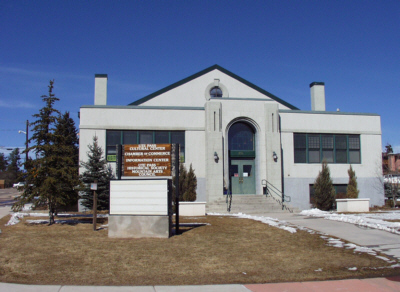
Ute Pass Historical Society Building
courtesy of Janet White, 2003
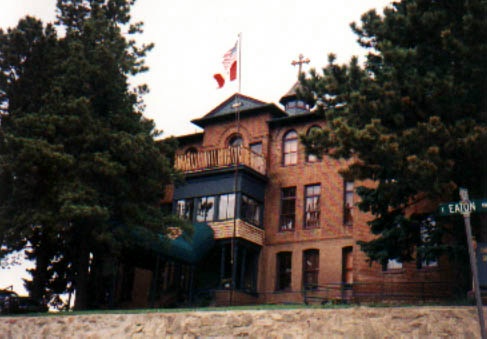
Old Hospital
Contributed by Mary Stanley
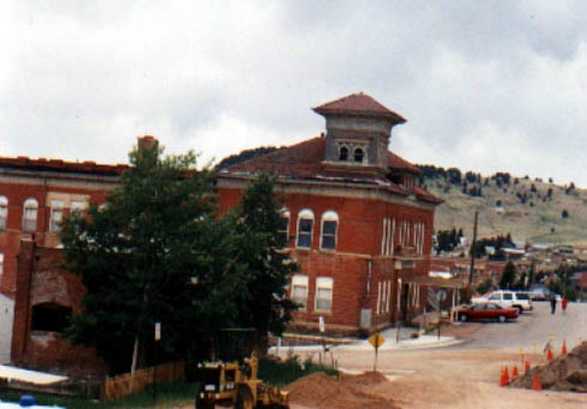
Old Masonic Lodge
Contributed by Mary Stanley
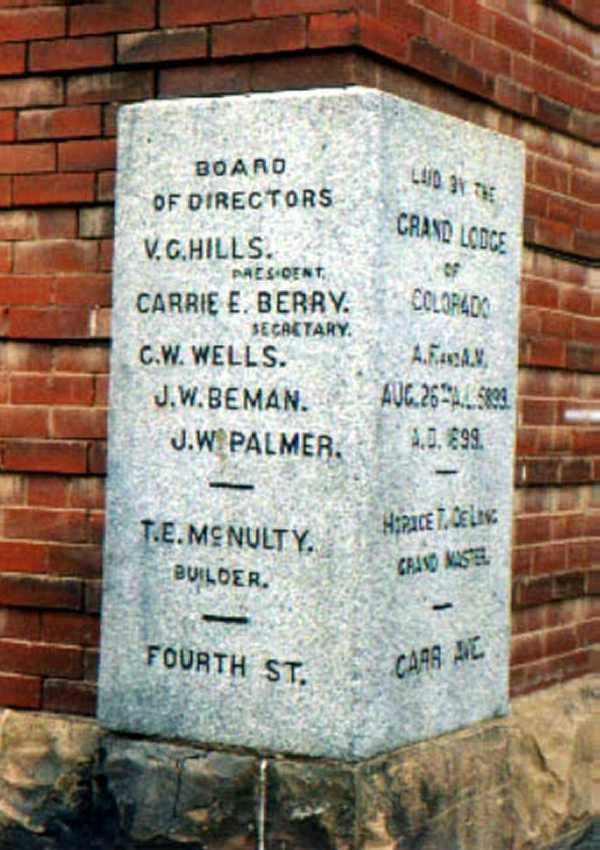
Masonic Lodge Plaque
Contributed by Mary Stanley
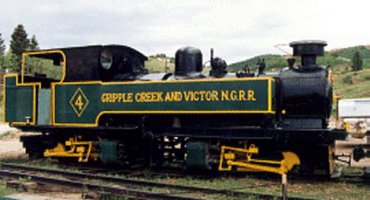
Cripple Creek and Victor N.G.R.R.
Contributed by David J. Sparks
Copyright © 1996- The USGenWeb® Project, COGenWeb, Teller County

This page was last updated
08/04/2026