

Haxtun must have been a quite attractive place to its
first settlers, with its gently rolling hills and fertile soil. Many of
these early pioneers were Civil War veterans, some were adventurers,
and others were just desperate for a new way of life. We may never know
their personal reasons for coming, but we do know that
While Haxtun officially became a town on July 1, 1909, its colorful history goes back to the early days of 1885.
The first Post Office was established in 1888, and one of the first settlers was Alice Strohm. Miss Strohm, who also served as the first postmaster, wanted the new town to be named Lillydale. However, she was overruled by a Mr. Emerson, who worked for the Lincoln Land Company. Instead, he named it after his hometown in New York, which sat on the banks of the Hudson River. Later, while surveying for the railroad, the land company bought Miss Strohm's and Miss Fletcher's (see Bio) land for $1,000.00 in gold.
The first stores in town were owned by Ben Raymon and a Mr. Hendrix, who ran a general store that also housed the post office. Mr. Hendrix and his wife always offered lodging to newcomers since the fledgling town didn’t have a hotel. Sadly, this general store was destroyed by lightning in 1901.
When the branch line of the railroad failed to be completed to Akron, most of the neighboring town of Bryant was physically moved to Haxtun.
Drake Mercantile Store: A two-story brick building built on the southwest corner of Colorado and Fletcher Streets. It housed the Farmers State Bank, (see bank robbery), a dry goods store, and a photography studio. Upstairs, an auditorium was used for graduations, lodge meetings, dances, and school plays.
Churches: The Methodist church was built in 1908 (with then-Governor Buchtel attending the dedication), and the Lutheran church followed in 1919.
Town Services: In 1917, the First National Bank opened in the building that now serves as the Town Hall. A water tower was erected in 1913 for firefighting and domestic use, and a power plant was built in 1917. Local utility rules were strict: town minutes from 1917 show that anyone caught sharing water with a neighbor who had an overdue bill would be fined.
By 1905, the town consisted of just 9 buildings and a population of 52. Because Haxtun was built in a lagoon area, it was highly subject to early-day flooding. A small creek northwest of town drained toward the east, regularly leaving Fletcher and Washington streets underwater. Local kids would float down the streets on homemade rafts, and it is even reported that one year, a resident named Ann Radford rode a small rowboat right down Colorado Street.
During 1910, many new town ordinances were passed. In September, the town marshal ordered a bell to enforce a new curfew. The law required all citizens under the age of sixteen to be off the streets and alleys by 10:00 PM unless accompanied by an adult family member. The bell—which was later replaced by a whistle—sounded at 9:45 PM to warn kids to head home. By 1912, town standards required sidewalks to be a sturdy 6 inches thick.
A 1911 ordinance mandated that all new buildings be constructed with fire-resistant materials. This was passed after a tragic cafe fire on the corner of Colorado and Ray Streets took the life of an 11-year-old girl and severely burned her father as he tried to save her. Demonstrating the community's tight-knit nature, the town board stepped in to handle the arrangements and guaranteed the burial expenses.
The town frequently rallied around those in need. In July 1911, when a Mr. L.A. Burnett contracted smallpox and left his family destitute, the town paid for his doctor, medications, and hired a private nurse from Denver to care for him. Later, in 1922, a 0.5 mill tax was levied to fund a town band, which provided summer concerts from a bandstand situated in the middle of Colorado and Fletcher Streets.
Today, the sounds of semis slowing down for the town limits, an occasional train whistle, or a plane overhead have replaced the older sounds of children playing at sunset, a cow calling to her calf, or the whinny of a horse. Yet, one tradition remains unchanged: the town whistle still blows daily to mark the passage of time at 7:00 AM, 12:00 Noon, 1:00 PM, and 6:00 PM.
Item of Interest:
Although Dr. Irving D Ramsay never practiced medicine in the state of Colorado, he had passed the examination with high grades. He was a brilliant man and has contributed greatly to medicine.
He is buried in the Haxtun Cemetery in the Ramsay Family plot. ClickHe is buried in the Haxtun Cemetery in the Ramsay Family plot. Click here to read the biography of him.
The town of Haxtun
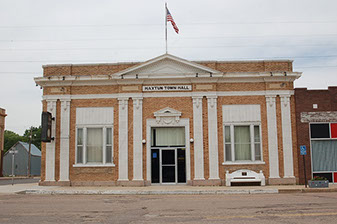
.jpg)
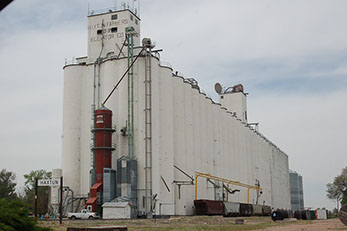
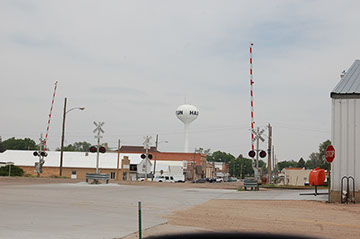
OVERALL OF TOWN
If you have questions, contributions, or problems with this site, email:
Coordinator - Rebecca Maloney
State Coordinator: Rebecca Maloney
Asst. State Coordinators: Betty Baker
If you have questions or problems with this site, email the County Coordinator. Please do not ask for specfic research on your family. I am unable to do your personal research. I do not have access to additional records.