

125 Years of History
With humble beginnings on the flat, treeless
plains of northeast Colorado, Phillips County celebrates its 125th
anniversary Thursday, March 27, while proudly looking back to its
history from 1889 to 2014.
This roughly 688-square-mile chunk of land
was once home to buffalo and then cattle herds, which roamed the prairie
as the Colorado Territory was introduced in 1861 and Weld County, one of
the original 17 Colorado counties, encompassed the entire northeast
corner.
Colorado became a state and entered the union Aug. 1, 1876.
Homesteaders began to settle in the Frenchman Creek area in the
mid-1880s to claim free land from the United States government through
the Homestead Act of 1865. They dotted the prairie with the
establishment of their sod houses and began to fence off their land.
Some have observed that this region was settled later than others
nearby, probably because there are no rivers.
Logan County was
created from a legislative act in February 1887, taking over the
northeast corner of Colorado and again encompassing present-day Phillips
County.
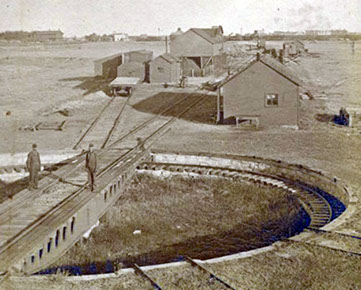
The Burlington-Missouri Railroad was instrumental in bringing
homesteaders to Phillips County. The rail was laid in northeast Colorado
in 1887 with a town site every 8-10 miles—Amherst, Holyoke, Paoli and
Haxtun. The round house is pictured at the Holyoke train depot.
March
27, 1889: Phillips County celebrates 125th
WRITTEN BY DARCI TOMKY
WEDNESDAY, 26 MARCH 2014
Holyoke Enterprise March 27, 2014
Activity really began to take off in the region when the railroad rolled
in. More homesteaders came when the Burlington-Missouri Railroad was
built from Holdrege, Neb., to Sterling.
Construction commenced in the
eastern part of the county in March 1887 and was completed to Sterling
in September of that year.
The B&M Railroad provided a town site
every 8 to 10 miles along the track. Thus Amherst, Holyoke, Paoli and
Haxtun began to take shape and were named by officials of the railroad
company.
On March 27, 1889, the eastern section of Logan County was
divided to form Sedgwick and Phillips counties.
Phillips County was
named in honor of R.O. Phillips, secretary of the Lincoln Land Company
that laid out a number of towns in this part of the country, and the
125-year history of Phillips County began.
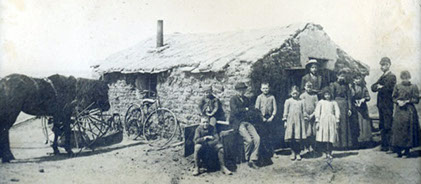
Agriculture has always been an important aspect of life in Phillips
County, from its 1880s beginnings to today. Sod houses dotted the
prairie as settler families took great care to farm the land and raise
their livestock.
County government established
Election
precincts were established in Phillips County July 8, 1889, and an
election was called for in November.
A week later, county court
convened with Judge J.H. Painter on the bench, commencing the judicial
system of the county court in Phillips County.
In November 1889, the
following county officers were elected:
Commissioners John C. Elder,
M. Francis and Theodore Chalbery; Sheriff L.C. Witherbee; Clerk and
Recorder C.E. McPherson; Judge James Glynn; Treasurer B.A. Hoskins;
Assessor Otis Castetter; Superintendent of Schools Charles B.
Timberlake; Surveyor William Lowe; and Coroner L.P. Lewis.
Holyoke was named the county seat.
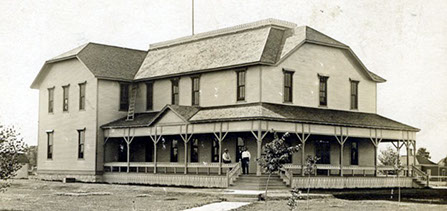
The former B&M eating house, originally located by the railroad depot,
served as the Phillips County Courthouse from 1904 to 1935. When it was
purchased for $3,000, it was moved to the current Phillips County
square, the 200 block of South Interocean Avenue.
Three courthouses
serve Phillips County
The first Phillips County Courthouse was a
hotel building on the corner of Baxter Avenue and Denver Street, which
was built by William Clemmons and rented to the county in 1889. The
county bought the building in 1901 and continued to use it until 1904.
The famed B&M eating house located by the railroad depot became the
second courthouse. Its doors were closed in 1899, and the county bought
the building in 1904 for $3,000. At that point, the county also
purchased the present courthouse block, the 200 block of South
Interocean Avenue.
The former eating house was moved to this new
courthouse square at a cost of $1,000 with a team of horses. The
T-shaped building would serve as the courthouse for 31 years, with its
polished floor of fine woods and a fireplace at one end.
In 1924, a
one-fourth mill levy was created to finance a new courthouse, but in
1931, due to the economic situation, the commissioners discontinued the
expense to taxpayers. The fund, however, grew to $27,319.17.

The current Phillips County Courthouse was built in 1935-36, with
Colorado Gov. Ed C. Johnson present for the laying of the cornerstone
ceremonies on Sept. 13, 1935.
In January 1934, the Public Works
Administration allotted Phillips County $53,000, of which about $23,000
was a grant and the remainder a loan.
A bond issue was required, so
in the November 1934 election, in a 462-298 vote, the county approved a
$26,000 bond issue to meet the federal grant.
In 1935, Walter Knudsen
was awarded the contract to build a new county courthouse. Razing of the
old building began June 17, 1935, and on Sept. 13, 1935, the cornerstone
of the present-day courthouse was laid.
Colorado Gov. Ed C. Johnson
was there for the ceremonies conducted by the Holyoke and Haxtun Masonic
lodges. Johnson and Supreme Court Justice Hazlet P. Burke spoke to a
crowd of approximately 1,000 people at the ceremony.
The new building
was accepted by county commissioners on May 8, 1936, and all offices
were open for business in the new facility the following week.
This
structure was placed on the National Register of Historic Places on Aug.
10, 2007.
Three courthouses serve Phillips County, Settlements,
post offices, schools Phillips County land
Phillips County has
never been large—by population or by square miles—but the towns and
communities that have been established in the county all have a rich
history and are the places that many call home.
Holyoke was the first
to be incorporated at an election held April 24, 1888.
Haxtun was
incorporated July 1, 1909, with Paoli following 20 years later, Aug. 6,
1929.
All of these establishments, as well as Amherst, were laid out
along the railroad in the mid-1880s.
Another railroad branch was
proposed from Holyoke to Akron, but it never materialized. Therefore,
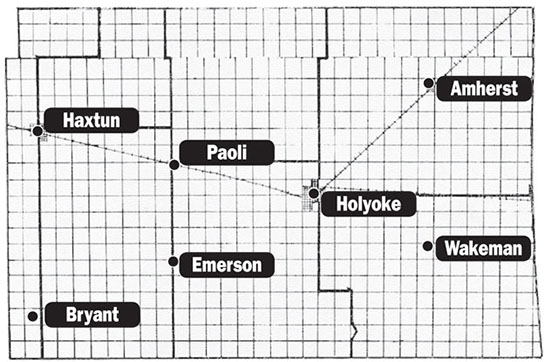
settlers in the small town of Bryant, about 12 miles south of Haxtun,
which would have been on that railroad, moved their buildings to Haxtun.
Located 7 1/2 miles west and 4 south of Holyoke, Emerson found itself in
the same situation as Bryant along the never-completed Holyoke-Akron
rail. Emerson, along with the settlement of Wakeman—7 miles east and 3
miles south of Holyoke—eventually disappeared as well.
Since
homesteaders were many miles from the nearest town, rural communities
were also established, such as Fairfield and Pleasant Valley, as
families came together for church, baseball and other activities
Phillips County, Colorado
Communication with friends and relatives
“back home” was important to settlers in early county history.
Therefore, several post offices were located across the county.
Post
offices and their start dates on record include Wakeman, September 1887;
Holyoke, November 1887; Amherst, February 1888; Bryant, March 1888;
Emerson, March 1888; Haxtum/Haxtun, April 1888; Paoli, June 1888; and
Starr, February 1907.
Currently, three post offices serve Phillips
County in Amherst, Holyoke and Haxtun.
As families began to settle in
Phillips County, schools started to pop up along the northeast Colorado
prairie.
By 1897, Phillips County had 36 separate school districts—a
number that remained fairly static until 1947, when the number of
districts began to dwindle. The county was reorganized in 1960, with 12
school districts in operation.
Most rural schools were grades 1-8,
with branch high schools at Highland Center, Amherst, Paoli, Fairfield
and Amitie. After two years there, students could continue at Phillips
County High School in Holyoke.
Phillips County School Districts, in
order of district number, included Fairview, Amherst, Sunnyside, Green
Prairie, Pleasant Valley, Highland Center, Prairie Star, Evergreen,
Hilltop, Sunbeam, Plainview, McKelvey, Pleasant Prairie, Pleasant View,
Silverbeam, Sunny Dale, Beachville, Grandview, Harmony, Prairie Gem,
White Star, Highline, Holyoke, Liberty, Fairfield, Morning View, Fairy
Dell, Philorado, Meakins/Glenwood, Morning Star, Amitie, Paoli,
Community Center, Broadway, Lone Star, Lakeside, Haxtun and North Star.
Today, Phillips County has two school districts in Holyoke and Haxtun.
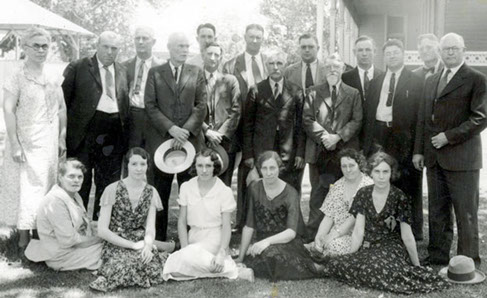
Phillips County officials gather together for a photo in 1931. They are
pictured from left, front row, Hattie Cole Lingo, librarian; Estelle
Brinkley Sanders, deputy assessor; Florence Stack Silligman, clerk of
county court; Edna Youtsey, superintendent of schools; Edith Correll,
clerk and recorder; and Geneva Behnfeldt Hassler, deputy clerk of
district court; second row, Mrs. Chas. Morris, janitor; R. Claymon,
commissioner; Ed W. James, bailiff district court; Steve J. Meakins,
commissioner; Frank McElroy, yard caretaker; Henry C. Hargreaves, deputy
treasurer; Thomas Hargreaves, treasurer; and Olin H. Helland, clerk
district court; and back row, Smith S. Worley, judge; A.C. Correll,
clerk and recorder; John Sandquist, commissioner; Frank A. Berger,
sheriff; Roy E. Owens, assessor; and Ben L. Garman, attorney.
County
marks 125th anniversary
While it was the railroad that really
kicked off activity in northeast Colorado, the agriculture industry as
well as other strong businesses keep the people of Phillips County
thriving in 2014, its 125th year.
As of the 2010 census, the
population of Phillips County was 4,442 people—the people who work hard
to make the county what it is today.
“We celebrate what we as a
county can provide to our citizens,” said current Phillips County
Commissioners Harlan Stern, Don Lock and Joe Kinnie.
“We celebrate
you, the hearty souls who continue to invest yourselves and continue to
make this a great place to live. We delight in seeing our children
raised with rural values and a great work ethic. Throughout the year of
2014, we hope to celebrate 125 years.”
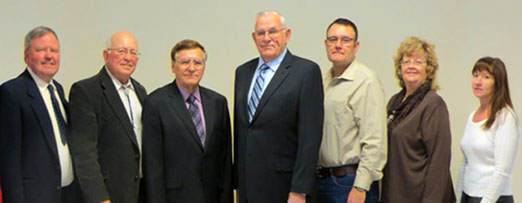
2014 officials at the Phillips County Courthouse are pictured from left,
Administrator Randy Schafer, Commissioner Joe Kinnie, Commissioner
Harlan Stern, Commissioner Don Lock, Assessor Doug Kamery, Treasurer
Linda Statz and Clerk and Recorder Beth Zilla.
If you have questions, contributions, or problems with this site, email:
Coordinator - Rebecca Maloney
State Coordinator: Rebecca Maloney
Asst. State Coordinators: Betty Baker
If you have questions or problems with this site, email the County Coordinator. Please do not ask for specfic research on your family. I am unable to do your personal research. I do not have access to additional records.